From Paper to Product: How Research Becomes Something the Market Actually Uses
Research does not magically become a product. The real transformation happens when technical novelty is translated into user value, engineering reliability, and a repeatable business model.
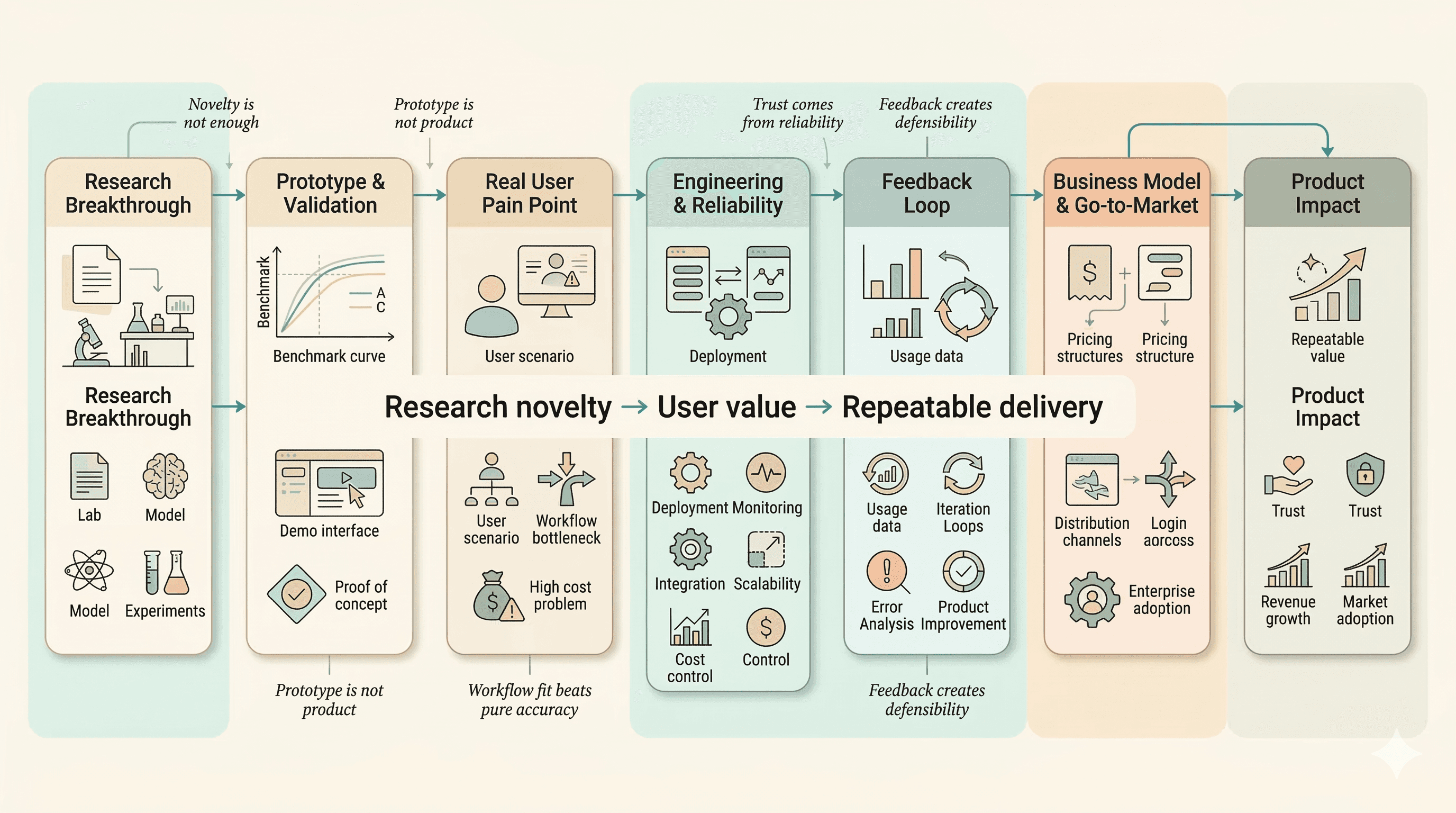
From Paper to Product: How Research Becomes Something the Market Actually Uses
A lot of research looks spectacular in a paper and strangely fragile in the market.
That is not because the science is weak. It is because research and products are optimized for different kinds of truth.
Research asks:
“Can we prove something that has not been proven before?”
Products ask:
“Can we make this useful, reliable, affordable, and desirable enough that people will keep using it and, ideally, pay for it?”
Those sound adjacent. They are not.
Between a publishable result and a successful product lies an entire canyon: use-case selection, engineering hardening, pricing, compliance, distribution, maintenance, onboarding, procurement, and a deceptively simple question:
Why would a customer adopt this now?
So turning research into a product is not “publish paper, add interface, launch website.”
It is a translation exercise: translating technical advantage into user value, and translating prototype feasibility into scalable delivery.
That is the real game.
1. The first hard truth: research value is not the same as product value
Research rewards novelty.
Products reward reliability.
In a lab, moving performance from 92.1% to 93.4% may be a meaningful breakthrough.
In the field, customers often care more about questions like these:
- Will it break under real traffic?
- Does it integrate with my existing stack?
- What happens when it is wrong?
- Who maintains it?
- Will it still work three months from now?
In other words, the best research solution is often not the best product solution.
Research tends to optimize for “better.” Products optimize for “good enough, stable enough, cheap enough, easy enough to buy.”
Case 1: PageRank did not become infrastructure just because it was clever
One of Google’s early breakthroughs was PageRank. Yes, the algorithm mattered. But users did not fall in love with a ranking paper. They fell in love with faster search, better indexing, a cleaner interface, and a consistently useful experience.
As research, PageRank was impressive.
As part of a product system, it became transformative.
Customers do not buy papers. They buy outcomes.
2. The first step is not “improve the technology,” but “redefine the problem”
When teams discover a promising technology, the instinctive question is often:
“How much further can we push the benchmark?”
A more useful question is:
Who would change their behavior today because of this capability?
This is one of the most common mistakes in research commercialization. Teams understand the technology deeply, but understand the user scenario only vaguely.
Productization does not begin when a technology could fit many places.
It begins when it becomes indispensable in one place.
Case 2: LLMs did not first win by “changing everything”
When large language models exploded into public view, the narrative was grand: this changes everything. That may be true in the long run, but it is not a product strategy.
The first real winners were not vague “universal AI platforms.” They were products that compressed model capabilities into specific, painful, recurring jobs:
- customer support assistance
- sales email drafting
- code completion
- document summarization
- enterprise knowledge retrieval
Why did these land first? Not because they had the biggest vision, but because they answered a very practical question:
Was the user already trying to solve this problem, badly, every day?
That is where research starts becoming product.
3. A prototype is not a product, and a demo is definitely not one
Technical teams often make an adorable mistake the first time they face the market: they build a dazzling demo and assume the product is 90% done.
Unfortunately, the demo usually proves only one thing:
This can be made once.
A product has to prove something much harder:
This can be delivered repeatedly.
Between those two statements lies a lot of missing machinery:
- boundary conditions
- reliability under variation
- failure explanation
- maintainability
- acceptable unit economics
Case 3: Why computer vision papers often lose to less glamorous systems
Many vision models look extraordinary on benchmark datasets and then become suspiciously mortal in the real world. Lighting changes, camera drift, dirty lenses, hardware aging, occlusion, shaky networks — reality is a very creative adversary.
In industrial inspection, retail detection, and surveillance-like workflows, customers are not always shopping for the smartest model. They are shopping for the system that:
- still works at 2 a.m.
- does not collapse when a camera is replaced
- keeps false alarms manageable
- comes with clear operational procedures
- has someone accountable when things fail
A deployable product is rarely “model + interface.”
It is usually:
model + data pipeline + annotation standards + monitoring + rollback + operations
That is why many companies with less glamorous tech still outperform more academically impressive teams. They productized the whole system, not just the algorithm.
4. Commercialization is not just selling technology. It is reducing risk.
Every time a customer buys a new technology, they are also buying uncertainty.
The newer your technology is, the more they worry.
So one of the most important jobs in turning research into product is not lifting the ceiling. It is thickening the floor.
Customers often buy control before they buy performance.
Case 4: Medical AI shows this better than almost anything else
Medical AI is one of the clearest examples of why research does not automatically become product. A model may look outstanding in a publication, but real deployment raises a much tougher set of questions:
- Does it generalize across hospitals?
- How does it fit into clinical workflow?
- Who is responsible when it is wrong?
- Does it satisfy regulatory requirements?
- Is it a recommendation tool or a decision maker?
- Which budget line pays for it?
That leads to a crucial rule:
The stronger the technology, the less guaranteed the adoption.
The higher the risk, the more important it is to enter through a small, controlled use case.
The best first product is often not full automation. It is assistance:
- pre-screening
- prioritization
- documentation support
- quality control alerts
- decision support
Not because the ambition is smaller, but because trust has to be built in layers.
5. Productization is not “adding software.” It is designing a value chain.
Many research teams underestimate this point: turning technology into a product is not only an R&D challenge. It is also an organizational, commercial, and operational challenge.
You are not just deciding how to train a model. You are deciding:
- Who is the first customer?
- Do we sell direct, through partners, or through a platform?
- Do we charge per seat, per API call, or by outcome?
- Is deployment cloud-based or on-prem?
- How long is the proof-of-concept cycle?
- Can one successful deployment be replicated efficiently?
Case 5: AlphaFold was not only a model story
AlphaFold gave the world a vivid picture of what AI could do in life science. But the real industrial significance was not merely “the predictions are good.”
The deeper value emerged when those predictions became part of a workflow:
- how researchers used the outputs
- how wet-lab teams validated them
- how prediction fed screening pipelines
- how results connected to drug discovery processes
A technical breakthrough creates leverage only when it becomes embedded in work.
Researchers are naturally sensitive to breakthroughs. Product builders must be equally sensitive to workflows.
A breakthrough without workflow becomes a conference talk.
A breakthrough inside workflow can become a business.
6. The most important system is often not the model, but the feedback loop
Many technical products do not fail because version one is weak. They fail because version one launches and learns nothing.
Productization is not a one-time shipment. It is a repeated process of narrowing the gap between problem and solution. That means one of the most important systems is not your model stack, but your feedback stack.
You need to know:
- where users drop off
- which customer segments are happiest
- what inputs fail most often
- which features are bypassed
- whether sales promises match actual experience
Case 6: Enterprise Q&A systems often win or lose on feedback design
When teams build internal knowledge assistants, the early obsession is usually obvious: better models, better RAG, better prompts, better retrieval. All of that matters.
But the products that survive usually get a different layer right:
- Can users flag a bad answer instantly?
- Does the system record “no answer” queries?
- Is the knowledge base updated regularly?
- Are permissions handled cleanly?
- Can administrators see failure clusters?
- Can content and indexing be corrected quickly?
In other words, the long-term advantage is not that the system answers brilliantly once. It is that the system becomes progressively smarter about its own failure modes.
That is a particularly important lesson for research-minded teams:
papers are about demonstrating success;
products are often about managing failure.
7. The teams that succeed learn to speak two languages
Research-to-product is also a communication problem.
You have to speak two languages fluently.
The first is the language of research:
accuracy, recall, significance, complexity, mechanisms, boundaries.
The second is the language of business:
efficiency, cost, risk, integration, retention, margin, delivery.
If a team can speak only the first language, it may build something everybody admires and nobody buys.
If it can speak only the second, it may sell well for a while but struggle to build defensible advantage.
The strongest teams connect the two:
- translating metrics into business outcomes
- turning business constraints into technical priorities
- fitting research cadence into product cadence
- converting pilot projects into repeatable offerings
That is when research stops being a beautiful engine hidden under the hood and becomes a visible competitive advantage.
8. A practical framework: six questions before trying to commercialize research
If you are evaluating whether a research result has product potential, start here.
1. Is this solving an interesting problem or a paid problem?
Some problems are intellectually irresistible and commercially irrelevant.
2. Is it better in a benchmark sense, or obviously better in a user sense?
The second matters more.
3. Can the advantage be reproduced consistently in real environments?
If it wins only in controlled conditions, the value will shrink fast.
4. Can it fit into an existing workflow instead of forcing a new one?
Changing customer behavior is usually more expensive than changing the model.
5. Do delivery costs improve with scale?
If not, you may have a services business disguised as a product.
6. Can the team coordinate across research, engineering, sales, and customer success?
Commercialization is never a solo act.
Conclusion: a paper is the beginning, not the end
The beauty of research is that it turns the impossible into the possible.
The beauty of product is that it turns the possible into the repeatable, purchasable, scalable.
So the real leap from research to product is not only technical. It is conceptual.
You have to move from “proving we are advanced” to “proving we can create value consistently.”
Yes, that usually means giving up some academic elegance and embracing a lot more engineering dirt.
But it is in that dirt that technology grows roots in the real economy.
After all, the best fate of a paper is not always to be cited.
Sometimes its best fate is to be used, depended on, renewed, and quietly woven into someone’s daily work.
That is when research becomes real.
One final image
If research is the invention of a new engine, productization is not painting it in attractive colors.
Productization is putting that engine into a car, adding steering, brakes, dashboards, repair manuals, supply chains, and a sales channel — and then convincing a time-pressed human being to actually press the accelerator.
That is the real art of turning research into product.