Explainable Innovation Engine: Turning RAG from Evidence Lookup into Method Discovery
An Agent-RAG framework that organizes knowledge as method nodes with dual-tree indexing, strategy-guided synthesis, and verification-based pruning, enabling explainable and controllable innovation.
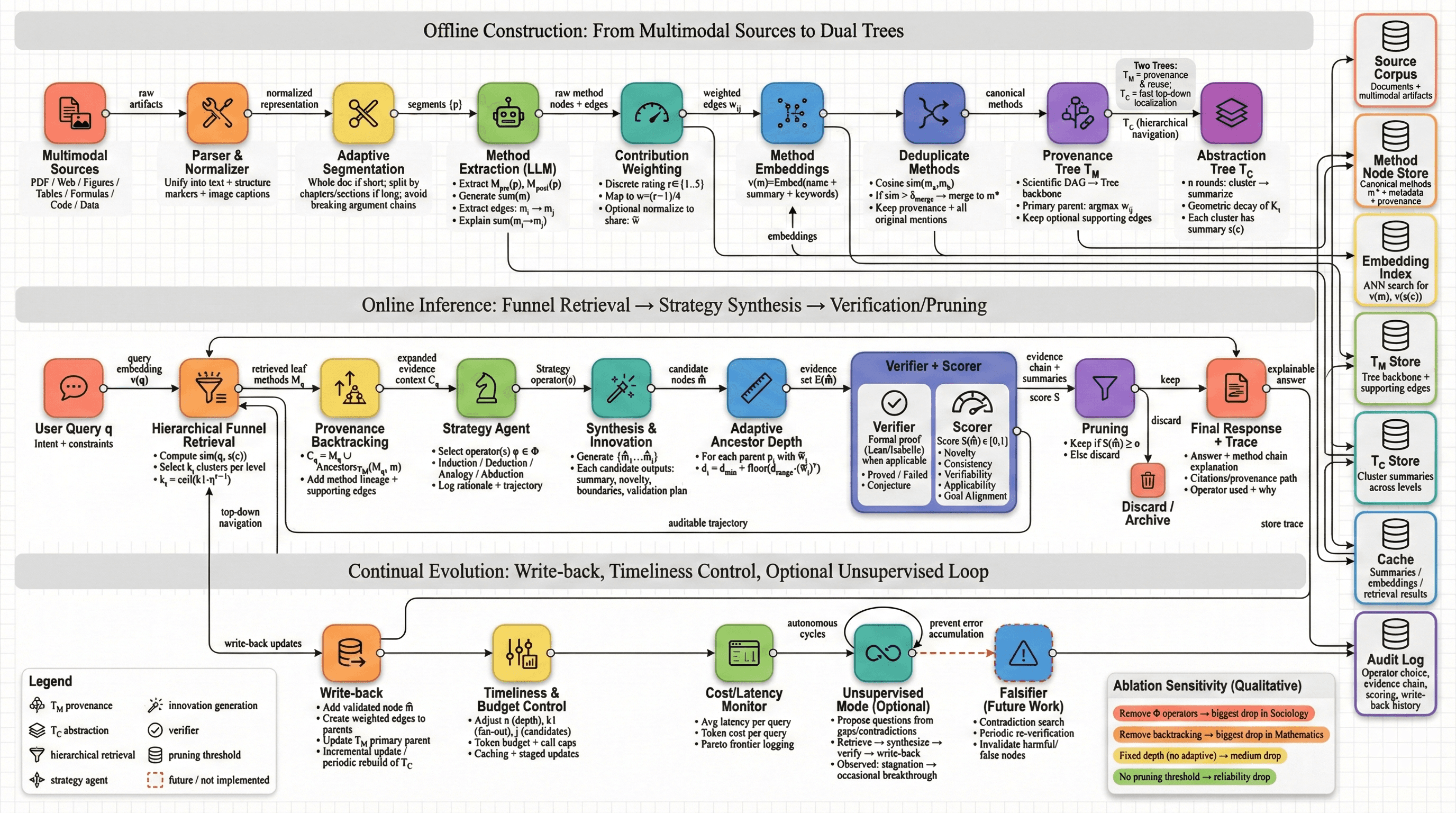
What This Research Tries to Do: Not Just Answer Questions, but Innovate — and Explain How
If you've used traditional Retrieval-Augmented Generation (RAG) systems, you probably feel both reassured and frustrated at the same time.
- Reassured: the model at least looks things up instead of hallucinating everything.
- Frustrated: the retrieved chunks often feel like shredded paper — enough to answer simple questions, but not enough to derive new ideas, reuse methods, or build reasoning chains.
The idea behind this work is straightforward:
Instead of retrieving text fragments, we retrieve reusable method units, allowing an agent to combine them into new methods along an interpretable reasoning chain.
The system then filters weak innovations and keeps strong ones, writing them back into the knowledge base so the system can continuously improve.
In other words, this is not just a question-answering system — it's a self-improving innovation engine.
Why Traditional RAG Is Not Enough
The typical RAG pipeline looks like this:
- Split documents into chunks
- Retrieve top-k chunks via vector similarity
- Concatenate them as context
- Generate an answer with an LLM
The problem is simple: chunks are not methods.
When solving tasks that require structured reasoning (mathematics, system design, scientific synthesis), chunk-based retrieval suffers from several issues:
- Broken dependencies: the premise of a method might appear in one section while its result appears elsewhere.
- Poor global coverage: top-k retrieval captures local similarity rather than the global structure of knowledge.
- Limited reuse: chunks are hard to recombine into reusable reasoning units.
Previous work already hints at the solution.
- RAPTOR constructs hierarchical summary trees for long-document retrieval.
- GraphRAG organizes knowledge as graphs with community summaries.
Both approaches show that structured retrieval works better than flat retrieval.
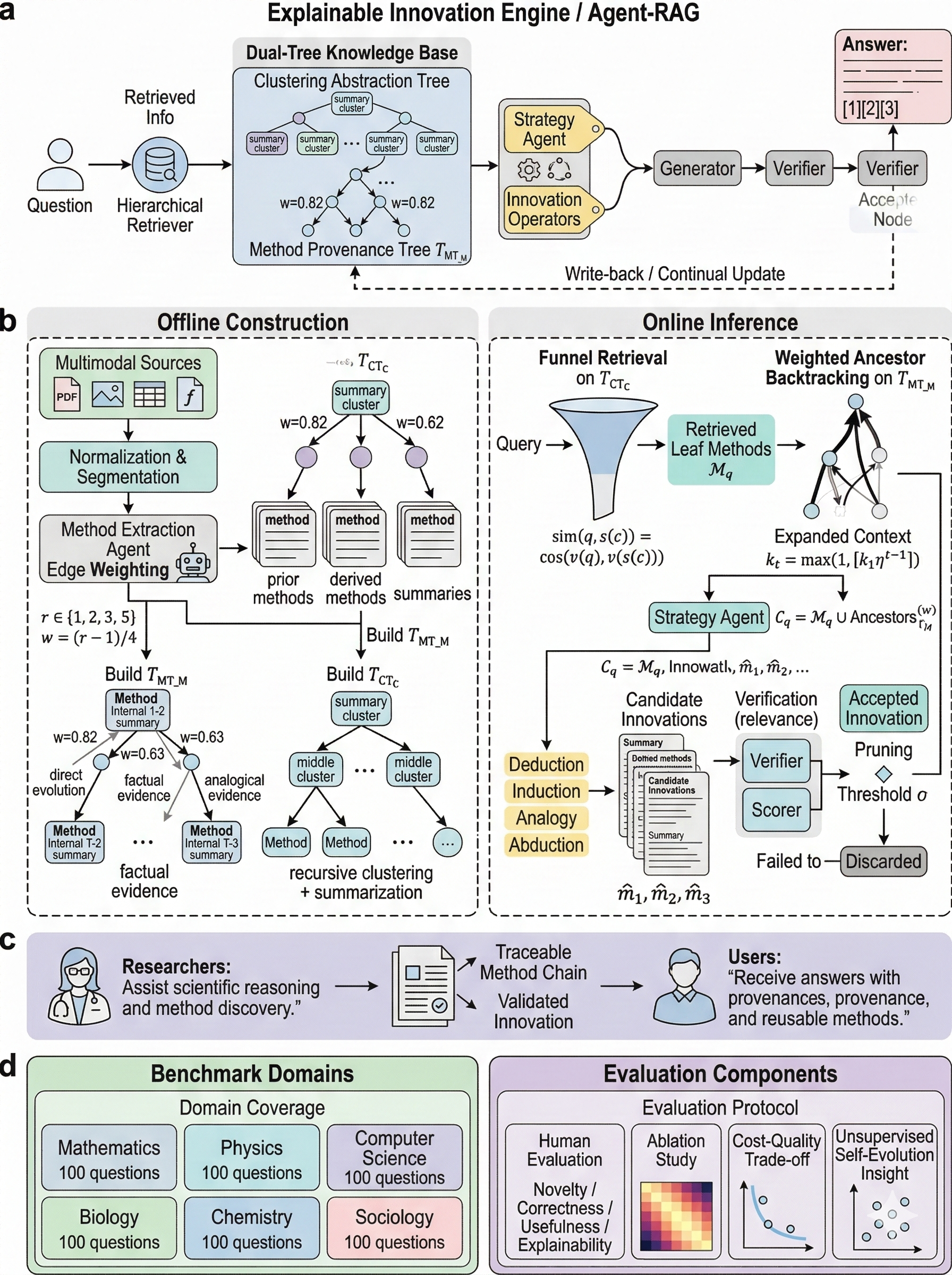
The Core Idea: From Chunks to Methods-as-Nodes
My approach replaces the fundamental retrieval unit.
Instead of retrieving text chunks, the system retrieves method nodes.
A method node could represent:
- a model architecture or training paradigm
- a theorem or proof technique
- an experimental design pattern
- a reasoning operator such as induction, deduction, or analogy
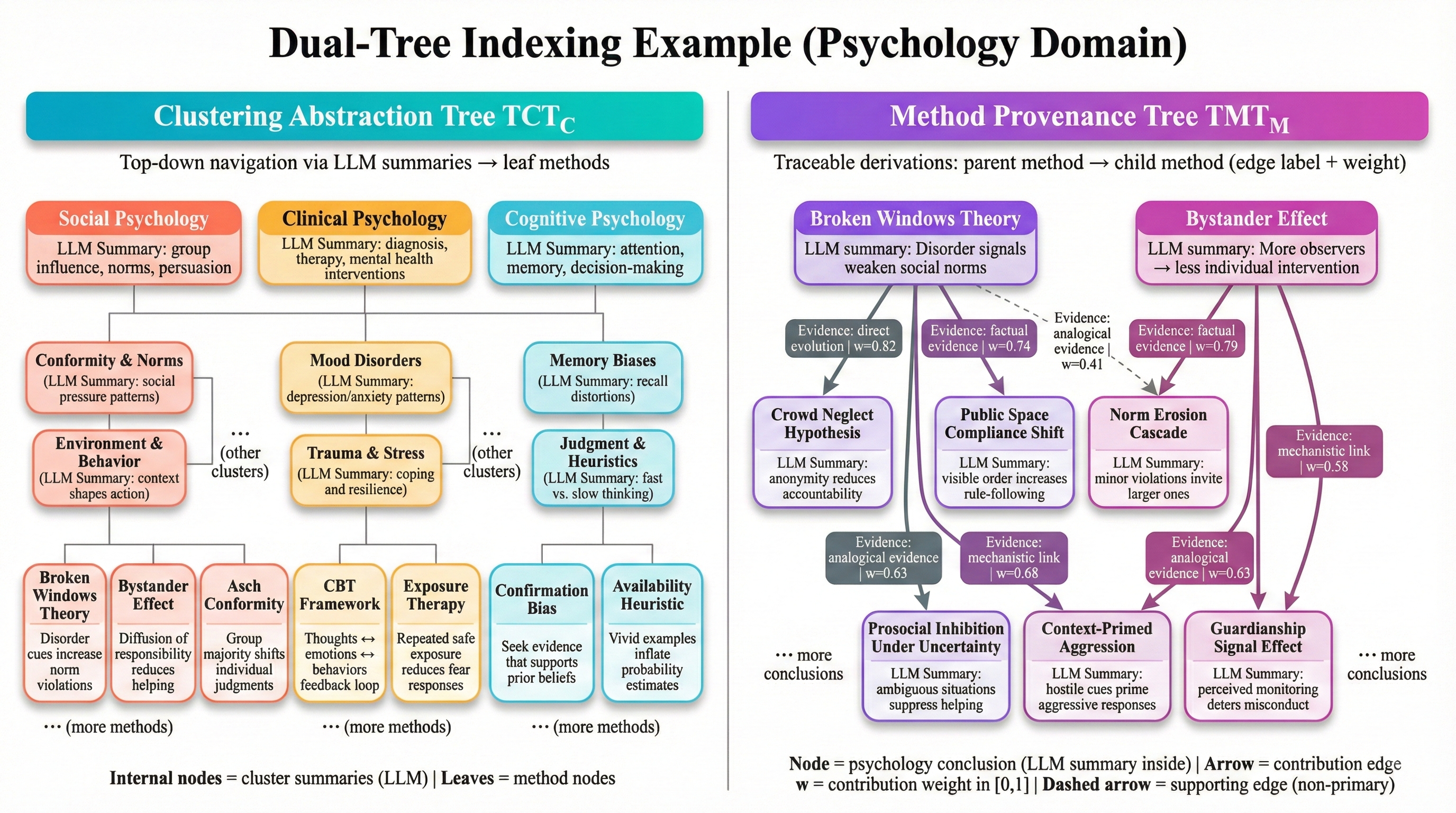
To organize these nodes, the knowledge base is structured into two complementary trees.
The Dual-Tree Knowledge Structure
1. Method Provenance Tree
This tree explicitly represents how methods derive from previous methods.
- Nodes: method units
- Edges: method → derived method relationships
- Edge weights: contribution scores in
In reality, knowledge forms a DAG with multiple contributing parents.
However, for efficient retrieval and visualization, the system keeps the highest-weight parent as the primary edge, while additional edges are stored as supporting evidence.
In short:
This tree explains where each method comes from and how it evolved.
2. Clustering Abstraction Tree
The second tree acts like a navigation map.
- Leaves: method nodes
- Intermediate nodes: clustered groups of related methods
- Each cluster has an LLM-generated summary
Moving upward gives more abstract themes, while moving downward leads to concrete methods.
This solves two problems:
- quickly locating relevant areas of knowledge
- navigating from abstract topics to detailed methods
The Online Reasoning Loop
When a user query arrives, the system runs a closed-loop reasoning process rather than a single retrieval step.
Step A: Funnel Retrieval
Search starts at the top level of .
The system compares the query embedding with cluster summaries and gradually descends toward leaf methods.
A decaying selection budget controls the search:
- wide exploration at high levels
- narrow selection at deeper levels
This prevents exponential branching while maintaining recall.
Step B: Weighted Ancestral Backtracking
After retrieving leaf methods , the system traces back their ancestors in the provenance tree.
Instead of using a fixed depth, the algorithm adapts based on edge weights:
stronger contributions → deeper tracing
weaker contributions → early stopping
This ensures that the context includes important reasoning chains without excessive noise.
Step C: Strategy Agent for Innovation
Innovation is handled through a library of methodological operators:
- Deduction
- Induction
- Analogy
- Abduction
The strategy agent selects appropriate operators based on the query and generates multiple candidate innovations.
Each candidate must provide:
- a concise summary
- attributed parent methods
- explanation of contributions
- novelty compared to prior methods
- applicability boundaries
- a validation plan
The entire reasoning path is recorded as an auditable trajectory.
Step D: Verification and Pruning
Not every innovation is useful.
Each candidate is evaluated across several dimensions:
- Novelty
- Consistency and explainability
- Verifiability
- Applicability boundaries
- Alignment with the user goal
Low-quality results are removed.
High-quality results are written back into the knowledge base, allowing the system to grow over time.
In domains like mathematics or geometry, the system can optionally integrate formal verification tools such as Lean or Isabelle.
Experimental Evaluation
To evaluate the system, I designed a human expert assessment protocol.
- 6 domains: Mathematics, Physics, Computer Science, Biology, Chemistry, Sociology
- 100 questions per domain (600 total)
- 4 backbone models
- Expert blind evaluation
Each answer was scored on:
- Novelty
- Correctness
- Usefulness
- Explainability
These scores were combined into a weighted final metric.
Key Findings
Two interesting patterns emerged.
Absolute performance
Sociology achieved the highest absolute scores, while mathematics had the lowest.
This makes sense:
- social science tasks rely more on conceptual synthesis
- mathematical reasoning requires extremely precise derivations
Relative improvement
However, the largest improvement appears in mathematics.
Why?
Because baseline systems often fail due to broken reasoning chains.
The structured method graph and pruning mechanism significantly reduce these failures.
In short:
The harder the reasoning task, the more valuable structured method retrieval becomes.
Ablation Studies
To understand which components matter most, I removed modules one by one:
- removing the methodological operator library
- removing ancestral backtracking
- using fixed backtracking depth
- removing pruning thresholds
The results were domain-dependent.
- Sociology relies heavily on methodological operators
- Mathematics relies heavily on ancestral backtracking and pruning
Cost–Quality Trade-offs
I also analyzed how system parameters affect performance:
- number of retrieval layers
- selection budget
- number of generated candidates
Increasing these improves quality — but only up to a point.
The quality curve quickly saturates, while token cost grows roughly linearly.
This creates a Pareto frontier, allowing practitioners to select a cost-effective operating point.
A Curious Experiment: Unsupervised Self-Evolution
One of the most interesting experiments was letting the system run without explicit tasks.
The agent generated questions, built new nodes, and wrote results back into its own knowledge base.
Three patterns emerged:
-
Long periods of stagnation
The system recombines existing ideas without major progress. -
Occasional breakthroughs
When a key node appears, the knowledge graph expands rapidly. -
A major risk: lack of falsification
If incorrect conclusions are written back into the knowledge base, they can propagate and amplify over time.
This suggests that a future version of the system should include a Falsifier Agent to periodically search for contradictions.
Interestingly, without ethical constraints, the system quickly proposed biologically unethical experiments — highlighting that pure optimization does not naturally encode ethics.
What This Work Contributes
In one sentence:
This work transforms RAG from retrieving text fragments into retrieving and composing structured methods, enabling innovation that is explainable, controllable, verifiable, and continuously evolving.
Future Directions
There are three directions I’m particularly excited about:
-
Falsification agents
Systems that actively search for contradictions and correct earlier conclusions. -
Stronger formal verification
Integrating theorem provers to ensure correctness in mathematical reasoning. -
Stricter reproducible evaluation
Adding stronger baselines such as chunk-RAG, RAPTOR, and GraphRAG.
If you are interested in making AI systems capable of innovation while remaining interpretable, feel free to reach out.