VulnAgent-X: From One-Shot Vulnerability Guessing to Evidence-Grounded Agentic Auditing
A layered multi-agent workflow for repository-level bug and vulnerability detection: risk triage → context expansion → specialist agents → selective verification → evidence fusion, aiming for higher recall, fewer false positives, and better interpretability.
Background: Why vulnerability detection is hard
Vulnerabilities rarely live in a single line of code. In real repositories, security issues often depend on:
- Interprocedural flows (source → sink across functions/files)
- Configurations and policies (authz rules, env vars, feature flags)
- Runtime conditions (only triggered by specific inputs/states)
- Project-specific conventions (custom sanitizers, wrappers, guards)
This is why one-shot “LLM code review” typically fails in two ways:
- False negatives: the model lacks the right context.
- False positives: the model produces a plausible story without strong evidence (unreachable paths, already-sanitized inputs, etc.).
Problem: The ceiling of one-shot LLM auditing
Even with strong code models, practical auditing still suffers from:
- Insufficient context for real data/control flows
- No verification to distinguish “suspicious” from “exploitable”
- No counter-evidence mechanisms to challenge claims
- Weak interpretability (conclusions without a defensible evidence trail)
So the key question becomes:
Can we turn vulnerability detection into a reproducible auditing loop that collects evidence, validates hypotheses, and produces actionable, review-ready findings?
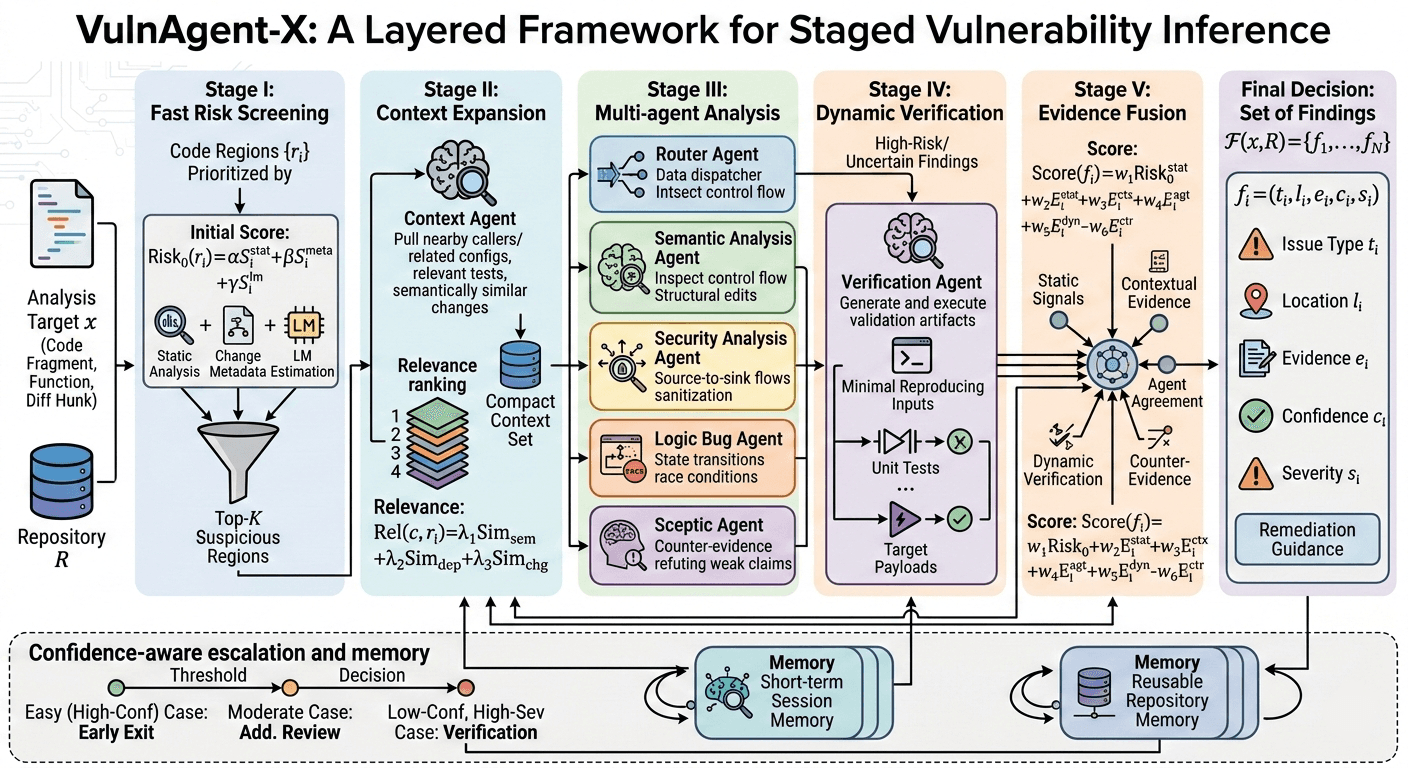
Method: VulnAgent-X (layered agents + evidence-driven decisions)
VulnAgent-X decomposes detection into five stages:
1) Fast Risk Screening
Low-cost triage to reduce the search space:
- lightweight static signals (dangerous APIs, missing checks)
- change metadata (auth modules, input processing, config diffs)
- lightweight model scoring
Only the Top-K regions proceed to deeper analysis.
2) Context Expansion (minimal sufficient context)
Instead of dumping the whole repo into the model, we retrieve a bounded, relevant context:
- callers/callees (call chain)
- configs and policy definitions
- tests and exception handling
- similar historical fixes
Goal: enough evidence, minimal noise.
3) Multi-Agent Collaborative Analysis
Specialised agents analyse the same target from complementary viewpoints:
- Router Agent: categorises the issue and dispatches experts
- Semantic Agent: control flow, boundaries, exception logic
- Security Agent: source→sink reasoning, injection/authz risks, dangerous sinks
- Logic Bug Agent: state/ordering/transaction/concurrency failures
- Sceptic Agent: searches for counter-evidence (unreachability, sanitisation, constraints)
This is not “more text”. It is structured evidence collection and adversarial cross-checking.
4) Selective Dynamic Verification
For high-risk or uncertain cases, a verification step generates:
- minimal repro inputs / payloads
- unit or regression tests
- bounded execution traces (if sandboxed execution is allowed)
This helps distinguish “looks vulnerable” from “is triggerable”.
5) Evidence Fusion
Final decisions are made via evidence aggregation:
- static + contextual + cross-agent agreement + dynamic signals
- minus counter-evidence
Outputs are structured findings:
- type, file/line localisation
- evidence trail (e.g., source→sink path)
- confidence and severity
- fix hints and regression test suggestions
Experiments: How we validate it
We evaluate:
- Detection quality: Precision/Recall/F1/AUROC
- Localisation: Top-1/Top-3/MRR
- Practical cost: tokens, latency, verification rate, early-exit rate
Public benchmarks (function-level + commit-level):
- Devign
- Big-Vul
- PrimeVul (more realistic evaluation settings)
- a just-in-time commit-level benchmark (detection + localisation)
What the figures highlight
- Pareto plot: performance vs cost, showing the benefit of layered escalation
- Sensitivity curves: performance saturates with larger K/context budgets while cost grows
- Threshold effects: how confidence thresholds trade off quality vs verification cost
- Error breakdown: environment-dependent semantics and missing helper-function meaning remain major failure modes
Key takeaways
- The main bottleneck is often not “understanding code tokens” but collecting and validating evidence.
- A staged workflow (triage → context → specialists → verification → fusion) improves reliability and interpretability.
- A dedicated sceptic/counter-evidence step is crucial for suppressing false positives.
- Verification can be selective: targeting only high-risk/uncertain cases yields strong gains without always paying full execution cost.
Limitations and next steps
- Environment-dependent vulnerabilities remain hard without stronger execution context.
- Dataset label noise can distort evaluation; auditing-style evaluation is preferable.
- Next steps include tighter integration into PR review workflows (review comments, patch diffs, and auto-generated regression tests).
Links to the paper and code are provided in the header.