01RELAY / THE STATIC FOUNDATION
First, make cognition
a reliable teacher.
Risk-calibrated human neural trajectory distillation. Cross-donor EEG relations guide training; only images are needed at deployment.
95% CI [7.38, 10.12]
×10⁻⁶ · anchor 0.753 · Table 3
Scope: 400 original problems, leave-one-of-eight-family evaluation and 10 paired initialization seeds. SD is across seeds; intervals use paired family-stratified problem resampling. Values are from the author-supplied revised manuscript.
View all baselines & statistical limits
| Method | Accuracy % | SD | NLL ↓ |
|---|---|---|---|
| ERM | 62.75 | 2.69 | 1.049 |
| Anchor-fixed | 63.00 | 3.60 | 1.049 |
| Anchor-selected | 63.38 | 4.21 | 1.035 |
| Raw-EEG | 64.50 | 4.02 | 1.008 |
| Static | 64.62 | 3.93 | 0.992 |
| Time-wise | 65.72 | 5.05 | 0.979 |
| Constant-rho | 66.55 | 3.28 | 0.952 |
| Full-space | 70.85 | 3.87 | 0.851 |
| RELAY | 71.47 | 3.18 | 0.827 |
The behavioral gain over Full-space is 0.62 pp, 95% CI [−0.33, 1.57], which includes zero. With six donors per role, the conservative distribution-free certificate selects zero transfer; the operational method uses independently estimated plug-in weights.
Start with a visual reasoning problem
CONCEPT VISUALIZATIONDiscover the rule. Complete the sequence.
Choose an answer. This is a website-generated teaching item.
Four student states. Eight cognitive windows.
Interactive probabilities and trajectories illustrate the mechanism; they are not per-item model logs. Empirical aggregates are shown above.
Shared structure, through individual noise
SEEDED SIMULATIONCROSS-DONOR KERNEL
Remove self-noise terms
Independent, zero-mean donor noise has zero cross-term expectation. Finite samples can still fluctuate and need not be positive semidefinite.
B = (ΣX · ΣXᵀ − ΣXXᵀ) / S(S−1)A teacher must fit the student's resolution
CONCEPT VISUALIZATION8 → 4 monotone alignment
Separate learnable error from the floor
STUDENT-COMPATIBLE PROJECTION
Repeated states share complete block rows and columns. Unexpressible temporal differences do not justify stronger supervision.
Trust the teacher in proportion to its risk
CONCEPT VISUALIZATIONRisk shrinkage experiment
When should we fall back to the anchor?
Assumptions: independent calibration, an unbiased teacher, and orthogonal teacher and anchor errors. Values use normalized illustrative units.
Align the geometry of a joint trajectory
Similar moments need not imply similar dynamics
A common isometry changes coordinates without changing joint relations. It does not identify a unique neural code.
The brain signals leave. Reasoning stays.
CONCEPT VISUALIZATIONThis intervention is a conceptual proxy, not an original intervention log. Real deployment uses images only; isometric alignment does not identify a unique neural algorithm.
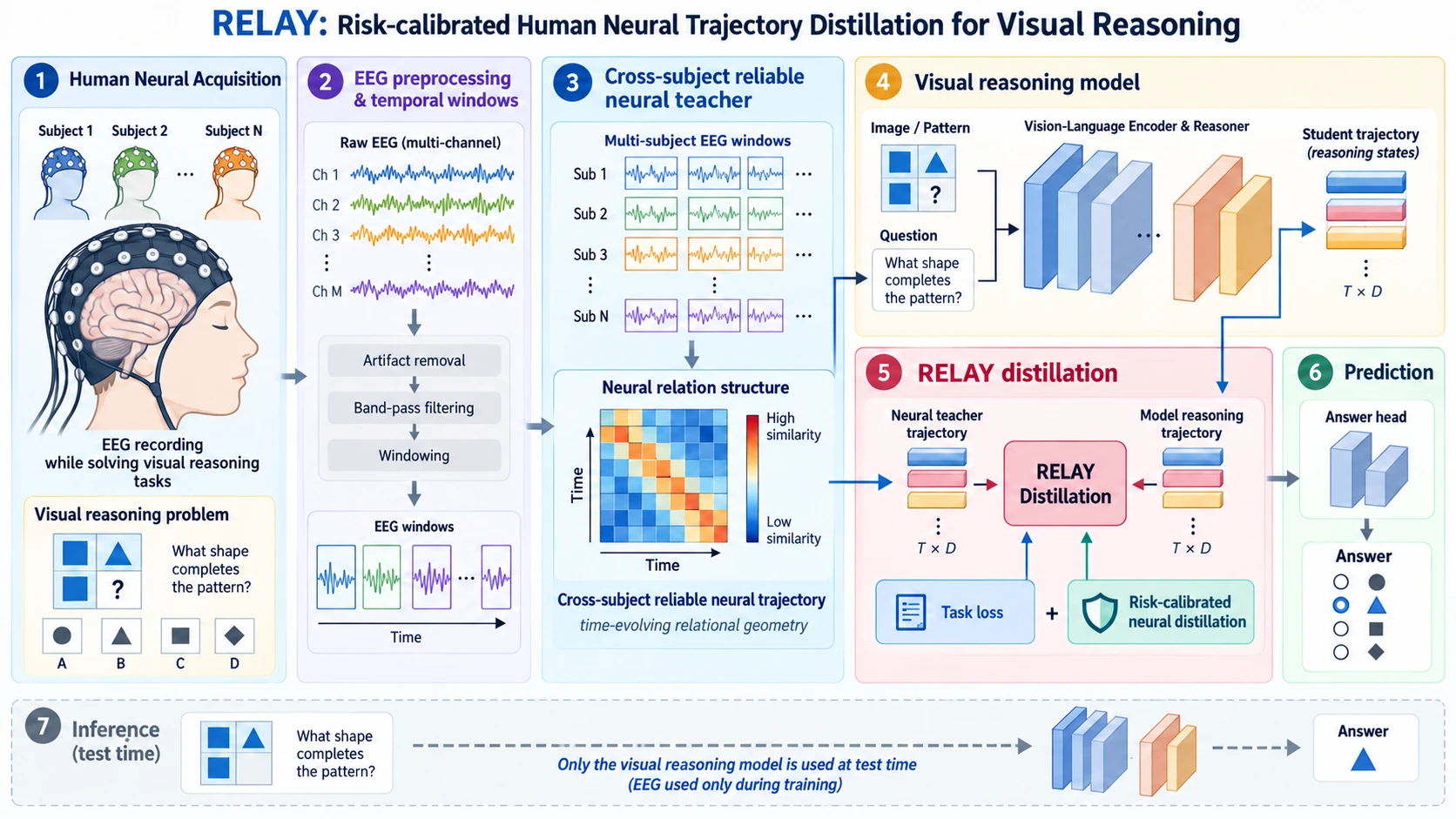
METHOD / AUTHOR-SUPPLIED FIGURE
The full path, in one figure.
From neural acquisition to visual students; from training-time distillation to brain-free inference.